City '26, Week 11: Harborside Carousing

Another Monday, another City26 blog post. I enjoy making these, but it is hard to pull myself out of the weekend slump to sit down and actually write. Maybe I should move these to a different day of the week? On the other hand, they're useful for getting my brain juices flowing again, and Monday is still my least-busy day of the week.

Today's entry is a d12 Carousing Table for Harborside, and I think it might actually mark the end of this district as well? That puts me at almost exactly three months to write a district, and with four districts planned, that basically lines up with a full year of City26! I was worried my timing had fallen off somewhere, but I guess not.

How do you make a Carousing Table?

When making or looking for a good carousing table, there are four things I look for in the entries. Not every entry has to have all four, and three is still a sign of an excellent entry. Having at least two of them is a good start, and having only one is fine but tells me I could definitely find a way to improve it. The four things I look for are:

  1. An element of choice. Simultaneously the easiest and hardest thing to include. In one sense, deciding to carouse at all is a choice, but I prefer something beyond that. If my decision to party leads to something happening to me, with no input, I don't find that very fun. A good GM can make up for this by using the carousing to tell a good story though.
  2. Storytelling potential. This ties back to not wanting something to just happen to my character. I think carousing is better if it leaves room to tell a story. Obviously if you're low on time and just want to get through the carousing, you don't have to spend the time delving deeper into a roll's results. But on the other hand, if you're just trying to hurry up and get through it, maybe you shouldn't have done carousing in the first place? 
  3. Consequences, either temporary or lasting. In the same way I don't think something unavoidable happening to me is fun, I don't think carousing is much fun unless there's consequences involved. The consequences don't have to be major, but something that can be referenced again later is always good, even if it's just a reputation as being "that one adventurer who got so drunk they did that thing".  
  4. Variety. Probably the thing least present in those "d10,000 carousing tables" and such that you find online.  Having 10,000 entries, or even 100, means that by default you're going to end up with a lot of really similar entries. Sometimes that's by design, and it can be a good thing! I love two or three similar entries with opposite consequences. But I don't want six different entries for "Lose at Gambling" where the only change is how much money you lost or who you lost it to. That's one reason I prefer small, location-curated carousing tables instead of a generic d100 table.

All that said, obviously not every entry on this carousing table fits those qualities! Like I said, getting all four in a single entry is hard. Even getting three of them is a challenge! And if you have just one quality in an entry, don't worry too much. I find that a second (or third) quality often arises naturally when you actually play the game. Like everything else in roleplaying games, a strong imagination and a creative spark helps with this. All that said, let's actually look at Harborside's carousing table:

A nighttime Porto street scene-- Rua das Flores, as far as I can tell.

Harborside Carousing Table (d12)

  1. You lose a fight with a sailor from out of town, making an enemy of them and their crew mates. If any event in the city involves sailors, there's a 2-in-6 chance it involves these specific ones that hate you. That's not all though. Roll a d6:
    1. You get away with nothing more than a few bumps, scrapes, and bruises.
    2. You get nailed with a black eye, which lasts for 1d4 days.
    3. A blow to the face knocks loose 1d3 teeth.
    4. The fight was in a popular bar. Most people in Harborside have heard about it, and might recognize you as the loser based on your description.
    5. The fight was in tavern, bar, or inn you regularly visit, and the owner is angry at you for damages caused during the brawl. You're banned from the premises until you pay for repairs and get back into their good graces.
    6. Roll again twice, combining the results (ignore further 6s, but doubles are fine).
  2. You win a fight with a sailor from out of town. Although you've made an enemy of the sailor themselves, they were unpopular with their crew, earning you renown among them. If any even in the city involves sailors, there's a 2-in-6 chance it involves these specific ones that like you.
  3. You're asked to join a game of cards or dice against some local dock hands. If you participate, roll a d20: on odds you win, on evens you lose. The payout is 3d20 silver pieces. If the payout is 35 sp or more, the dock hands can't afford it, and offer their services as laborers or bodyguards, or some other unspecified favor.
  4. You are drawn into a conversation with the most beautiful person you've ever seen. Words flow between you without issue, and you both seem attracted to each other. However, the conversation ends poorly when (roll d4):
    1. You fumble a few words, and when you try to recover you accidentally insult them. You can either try to salvage the night, knowing you're already on thin ice, or walk away heartbroken but without further damage to your confidence.
    2. Their spouse/lover arrives at your table, just as you make a move. Decide whether to keep pushing or back off. If you take a leap for love, the spouse demands a duel of honor, to first blood. Seeing as they're not a trained fighter, first blood might mean their death, which would understandably upset your potential paramour.
    3. You black out, then wake up the next morning with a pounding headache, and no memory of what happened after the conversation. There is a token of affection in your pocket that you recognize as belonging to the stranger, as well as a playing card with some numbers on it. Unfortunately, you also don't remember what the numbers mean.
    4. When the stranger steps away to get drinks, a trusted ally carousing with you implies that the stranger is just trying to scam you. There are some signs (they've expressed great interest in your work and how much you make) but you feel a legitimate connection. Decide whether you're going to walk away while they're gone, or stick around and take a chance. (Feel free to roll a d20 to determine their intentions, innocent or devious, based on odds-or-evens.)
  5.  You wake up the next morning to find yourself on a dinghy out at sea. You can see the city's port in the distance, but only have a single oar. Returning to shore takes 1d4 hours, and when you arrive you find a search party-- not for you, but for the stolen dinghy, which belongs to the Harbormasters. Plus, sleeping all morning exposed in the sun has left you with a terrible sunburn.
  6. Once under the influence of alcohol (or other substances) you end up expressing an incredible talent you didn't know you had-- singing, dancing, painting, etc. Elaborate on the talent as necessary, which is impressive to those around you. The next morning, a talent scout from the Terra Nova district seeks you out. Unfortunately, you fail at demonstrating the talent again. Perhaps it only appears while you're drunk?
  7. You wake up the next morning to find yourself in a sewer tunnel, surrounded by candlesticks. Finding your way out takes 1d4 hours. When you return to the surface, the district is abuzz with gossip-- in the night, nearly every home in one neighborhood was broken into, but the thief took only candlesticks. Later in the day, you're approached by a member of the Rovers, who congratulates you on "winning last night's bet". They hand over 2d6 silver pieces, then ask where the candlesticks are. Hopefully you remember how to get to them!
  8. In the course of the night, you make a friend out of a young bachelor(ette) from a well-to-do family, who's come to Harborside for a taste of the "low life" before they get married. Because you get along so well, they invite you and your companions to join them and their friends on a party barge they rented for the night. As you continue to talk, they describe their fiancee, who is wealthy but sounds like an awful person. You know that, in their inebriated state, you could probably persuade them to break off the marriage. But doing so might risk the ire of their family, and perhaps the bachelor themselves when they wake up tomorrow morning, with their mind less clouded by drink. 
  9. You wake up the next morning a location only mildly familiar to you, but definitely not where you're supposed to be staying. You don't remember how you got here, but there's a package nearby with a note attached. It has your name on it, as well as the name of a street you don't recognize, and the line "payment upon delivery, as agreed." Unfortunately, there aren't any other details, and you don't remember agreeing to anything. The package is wrapped in brown paper, tied with twine, and sealed with wax stamped by a signet ring whose symbol you can't quite make out.
  10. During your carousing, you fall in with a charismatic stranger who really knows how to party. Even better, they seem to enjoy your company. They live in Terra Velha, and claim to know the best spots for a good time there. Unfortunately, they don't vibe with your companions, and refuse to bring them along. If you choose to abandoned your allies, roll a d20. On odds, the stranger does as promised. Roll twice on the Terra Velha carousing table and take either result, always benefiting from the best possible consequences of a result. On evens, it turns out the stranger hates your guts (for unspecified reasons) and tricked you into an awful night of debasement. You wake up the next morning terribly hungover, missing a sixth of your coinage, and having made an enemy of someone important in Terra Velha (someone other than the stranger, who you probably consider an enemy now).
  11. Recognizing you as strong and/or competent, one of the bouncers at a bar asks you to take their place while they quickly run to the bathroom. If you accept, they don't return. The owner has seen you at the door, and assumes you're an official replacement. Stay, and you'll likely get the money the bouncer was owed for the night instead. Leave, and if anything happens the owner will probably hold you liable and remember your face. (Roll a d20 to determine if anything goes down at the bar, based on odds-or-evens.)
  12. Perhaps emboldened by a stomach already full of alcohol, you are drawn into a contest run by a local dive bar. If you can finish six shots of a local liquor (a powerful, cane-based alcohol that always burn as it goes down) then you win a round of free drinks for yourself and your companions. Failure, however, means you must pay the cost of all six shots (as inflated by the bar's owner), suffer the humiliation of defeat, and become so drunk you end up making another poor decision tonight (roll again on this table, always suffering the worst possible consequences of a result). 
City '26, Week 10: The Sailcloth Guild (Harborside Faction)

After two and a half months of near-daily writing, I find myself almost at the end of the first of four (maybe five?) districts for my City '26 project, Port Callus. This is definitely the longest I've ever stuck with a daily writing project, hands down. My previous record is, depending on how you look at it, two months, which was really two separate writing projects, each a month long. I now have only two major entries left for Harborside, and have begun to make some outlines for the next district in the city, Terra Nova.

I think the majority of my persistence can be put down to the decision to use Porto as the major inspiration. I could definitely have still done some of this without an existing city to base it on, but many of the overarching elements of the city's layout and structure have basically been taken out of my hands, in the best way possible. When it comes to writing, I often think about the quote "Restriction breeds creativity", and I think that's very true for all of my work.

Enough about that though, let's get into the actual meat and potatoes of today's look into Port Callus-- a new faction, the Sailcloth Guild.

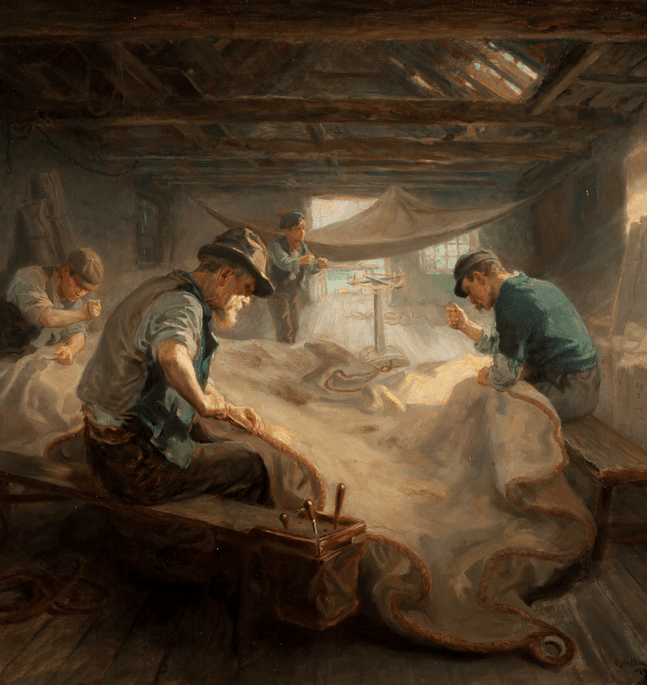
The Sail Loft (1908) by Ralph Hedley 


What is the Sailcloth Guild?

A port means ships, and in the era before oil-powered engines, that means sails. Sails, of course, mean miles and miles of heavy canvas cloth for making those sails. As Port Callus is designed to be a "city of guilds", enter the Sailcloth Guild, the people responsible for that work. They're not a very large guild, by the numbers, but they're an economic and political powerhouse... when they need to be. Their work, as an extension of weaving, trimming, and other "women's work" doesn't necessarily receive the respect it should from the city's other guilds and artisans. Since the guild is also one of few led by women, this puts them in a precarious position.

Port Callus is a pseudo-historical fantasy setting, so it doesn't need to directly reflect the culture and outlooks of the period it's channeling (roughly the mid-1700s). However, I do want class structure, political struggle, ideas of self-determination, and economic disparity/exploitation to be prominent themes, especially where they overlap with other themes like gender. I can't always capture those ideas perfectly, but I want them to be elements that linger on the edge of the setting, almost able to be forgotten-- right up until they come front and center, unable to be ignored any longer.

Who They Are

Like my other factions, I start with three major NPCs. In this case, all three are leaders for different sub-factions within the Sailcloth Guild. In the fiction of the setting, these sub-factions arose naturally as a result of the division in labor within the guild. Their work, important and big but consolidated into one place, has allowed them to be early adopters of the "Industrial Revolution" style of keeping subsets of workers focused on discrete tasks. For the Sailcloth Guild, that means (roughly-speaking) weavers, in charge of turning linen thread into canvas; cutters, whose job is to measure the cloth, cut it, and then form it into the appropriate shapes; and the carriers, the people in charge of rolling up the sails, and getting them to the ferrymen who bring it to the docks.

 Leandra Vidal (F, Guildmaster)

  • Motive: "Our work is the lynchpin of the city's trade. Without it, everything cracks, breaks, and eventually falls. We shouldn't abuse that, but we shouldn't let those high and mighties at the Freemen's Guild forget it either."
  • Means:
    •  Handles every part of the ordering process, including setting fulfillment times and deciding the pace for completing work orders.
    • Has a mind for numbers, letting her balance checkbooks and know exactly how much canvas is needed for an order (even accounting for possible accidents; she's basically never wrong).
    • Hard-edged, no-nonsense attitude; doesn't take shit, and gives as good as she gets. Outside of arguments, she's exceedingly friendly and easy to like, like that grandma who first taught you to swear.
  • Opportunity: If negotiations with the other guilds don't go her way, she isn't above throwing her guild's weight around, but prefers subtlety (like hiring outside help) to direct action.

Carmo Venancio (F, Lead Spinner)

  • Motive: "The work is all that matters-- more than financial disputes, more than power struggles, and more than the life of any one person."
  • Means:
    • In charge of the guild's spinners, who actually weave the linen into canvas, which also make up the majority of the guild's workers. They are more dedicated to Carmo than they are to Leandra, the guildmaster.
    • Impossibly quick hands, created from a lifetime on the docks as a pickpocket, followed by another lifetime on the production line.
    • She's as old as spit; definitely the oldest person in the guild, and maybe the oldest in all of Harborside. That doesn't seem like a strength at first, but it means everybody and their grandmother knows her, and everyone who doesn't always underestimates just how stubborn she can be, and how committed she is to the guild's work.
  • Opportunity: If the guild comes under risk of falling apart, or stopping their work, then she'll do anything it takes to keep it going. Anything. Carmo's lived her whole life in Harborside, and before she was a spinner, she was a survivor.

Amelia Valente (F, Lead Hand)

  • Motive: "I don't see why we should be tamed. They don't appreciate what we do. They see it as women's work, but I think the time is fast coming for us to show them all just how much they need us."
  • Means:
    • In charge of the guild's cutters (responsible for turning canvas into measured sails) and the carriers (everyone on the "supply" side, responsible for taking the sails where they need to go).
    • Piercing eyes that don't miss anything. One look at a sheet of canvas and she sees every flaw. One look at a crumpled roll of linen and she knows just how many meters there are. One look at a shipment, and she knows whether it's been tampered with.
    • Scathing in every interaction, with a tongue as sharp as the knives and scissors on her belt. What few compliments she gives are terse and short, like lines of steel, but always feel earned. She cultivates unflagging loyalty, and good words from her are words you carry for the rest of your life.
  • Opportunity: If she sees a moment of weakness, she jumps on it, no matter where or when. It's not that she doesn't care about consequences, she just knows that she can handle them. Nothing draws her ire like the Freemen's Guild though, which she loudly and frequently criticizes as a circus of fools, "barely capable of leading their own asses to the privy" much less in leading the city to prosperity.

What They Have

Unlike the Rovers (the previous Harborside faction) the Sailcloth Guild has direct access to a lot more money, people, and influence. Those things are assumed to be in their assets, so this list focuses on specific assets like property or ongoing situations that can be turned to their advantage.

  1.  Factory and Workshop: Located outside of Harborside, up the river and away from the harbor, high on a cliff in what is technically Terra Nova. It sits on a fairly large plot of land, and was built there decades ago, before the district was the home of the nouvea-riche merchant class. The property includes more than just the factory and workshop, extending from the closest streets (where properties pay rent and taxes to the guild) all the way down the cliffside to the river (where the guild has a private dock for bringing in linen and shipping out sails).
  2. Ferryman's Guild: The Sailcloth Guild and the Ferryman's Guild have strong ties that stretch back generations, to a time before the Freeman's Guild was established. The ferrymen transport the guild's finished sails downriver, while their own boats rarely require sails. Those that do need them get the product at a steep discount. Altogether, this means the ferrymen are likely to support the Sailcloth Guild in any political moves they make, and vice-versa. Splitting their causes would be nearly impossible without incredible leverage.
  3. Floating Credit: Many of the foreign merchant ships that purchase sails in Port Callus can't afford the cost upfront. This isn't surprising, and most merchant ships have a network of debt that criss-crosses the continent, backed by banks, guilds, and city governments. The Sailcloth Guild, however, is older than most banks, and doesn't accept outside credit. Instead, purchases from them by merchant ships are backed by a combination of the Harbormasters, the Merchant's Council, and the Freemen's Guild, letting them take on the debt of merchant ships and make a profit via interest. This represents a significant unpaid cost, however, and if the Sailcloth Guild began to refuse the consortium's credit (or even worse, called in the outstanding debt) it would be disastrous, and practically bankrupt at least one of these organizations if mishandled.

How They Act

With the rising levels of crime found in Harborside and Terra Velha, where most of the guild's membership (usually women, often older) actually lives, Leandra the guildmaster felt it important that members be able to defend themselves. To that end, workers are taught how to fight using the tools of their trade-- spinners wield pairs of needles like stilettos, while cutters use square-cut knives in one hand and razor-sharp scissors in the other. Everyone else is taught using billy-clubs and batons, and issued a small, single-shot pistol (supplied and paid for by the guild).

What They Want

  1.  Ensure an ongoing, stable income for all members of the guild, without fear of increased fees from the Freemen's Guild. If the workers in the guild can't afford daily meals, a roof above their heads, and enough savings to stay comfortable when they can't work anymore, what's it all for then? Luckily, the guild is successful, even if each order is sold for less than the sum of its work should be worth, and the necessity of their product means they always make more than enough. However, their prosperity draws constant aggression from the Freeman's Guild, who tries to saddle the Sailcloth Guild with larger fees to offset their own costs.
  2. Expand their work, establishing formal contracts with merchants who frequent Port Callus on their trading routes. Although they don't accept credit from foreign banks, the guild isn't against working out an agreement with a trading company they can trust. As a sub-goal to this, the Sailcloth Guild wants to build these contacts without the help (or intervention) of the Freemen's Guild, so that the contracts stay solvent even if something happens to the Freemen's Guild.

 Who They Know

As a major guild with a representative in the Freemen's Guild, the Sailcloth Guild has many enemies and allies, all at varying levels of trust and enmity. This isn't a comprehensive list, but a collection of the biggest names-- the people they can always trust, who would almost never turn against them; and the people they're suspicious of, who are always plotting to undermine them.

Allies

The Ferryman's Guild: Close collaborators of the Sailcloth Guild, who benefit from their work at little cost to themselves. Their connection goes back to the oldest days of the city, before it achieved its own independence, and before they were the only formal guilds for ferrymen or sail-makers. They have a working contract, more a formality than anything, which itself is nearly 100 years old. By its own terms, the contract is renegotiated every 10 years, or whenever agreed upon by both parties.
The Green Fleet: A trading company and fleet of merchant ships owned by the Green Merchant, an enigmatic figure from another nation. No one knows the Green Merchant's true identity, but they've got dozens of ships at their command, and sit at the confluence of several economic networks. Many of the Green Fleet's ships regularly resupply at Port Callus, taking advantage of its competitive prices and relatively loose regulations. Because of this, they have strong ties with many of the suppliers for ships, including the Sailcloth Guild.

Enemies

The Freemen's Guild: On paper, ally; in practice, a neutral party; in times of struggle, a definitive detractor. The Freemen's Guild is led by council, and although the Sailcloth Guild has a sitting representative, most of the other council members are from wealthy families. They resent members from the lower-class, including the Sailcloth Guild, which for some council members has become a stand-in of everything they hate about Port Callus's underclass.
The Weaver's Guild: This conglomerate of smaller guilds started as a collection of well-to-do clothiers, who over time absorbed the smaller, less-powerful and less-wealthy guilds responsible for making their materials. At some point they absorbed the old Weaver's Guild but kept the name, giving them an appearance of workmanship to outsiders, that belies their nature as money-hungry businessmen with a finger in every pie they can reach. The only weaving-adjacent guild they haven't managed to tie to themselves are the Sailcloth Guild. Attempts to make it otherwise are backed by some in the Freemen's Guild, but constantly blocked by several major players including the Sailcloth Guild themselves, the Harbormasters, and the Merchant's Council.

City '26, Week 8/9: Harborside – 2d5 Random Encounters

 Well it's been a quiet two weeks on this blog, but not for lack of work! In spite of everything, I have still managed to sit down and do a single City '26 entry every day. Some have been easier than others, definitely, but overall I'm still really enjoying the experience. The deeper into it I get, the more I appreciate my decision to base Port Callus on my new home of Porto. Every time I step  outside of my routine (not happening much these days because the weekends are still a little grey and cold) I find myself full of inspiration. 

That's been especially helpful for this week's completed entry, which is a Day/Night encounter table for Harborside, the river district I've been working on. Some of these entries were pulled wholesale from thin air, while others are inspired by things I read about the city and places I see (sometimes blended with half-remembered encounter tables from other games). 


A view from the Ponte Luís I, one of the city's major bridges, looking toward Gaia (a sort-of neighbor, sort-of the same city). Not representative of right now though, in the days before spring.

As far as encounter entries go, they aren't bad. They could use some improvement, but I'm trying to keep everything here "editing lite" (I would say unedited, but I'm the type of fool who can't help but edit as I write). Some of them lack the punchy-ness I usually like in my encounter tables, and maybe fall a little too heavily into being an immediate problem to be resolved. But they're all open-ended– something I've seen a few people complain about in regards to encounter tables, but it's what I prefer. If an encounter is open-ended enough, it means I can tweak some aspects the next time I roll it, or take the resolution and use it as inspiration the next time I roll the same result. I find "repeating" encounters in this way does a lot of lifting in building out a setting and getting that "living, breathing city" thing going.

Harborside – Encounter Tables

Daytime:

  1.  As the party passes along the river, a vendor at a nearby stall call out, attempting to draw them close. The vendor sells a variety of jewelry, and has singled out the party because they have a bracelet/watch that matches perfectly with one of the PC's outfits. The vendor is offering them a "special deal", and the price is actually quite excellent– however,  it isn't so low as to cause suspicion, and the item is clearly of good (though not particularly high) quality. Closer inspection might reveal it's actually made of a cheaper material than the shopkeeper claims, such as pyrite instead of gold, polished steel instead of silver, etc. If the party walks away though, the vendor does everything they can to stop them, and appears to be absolutely desperate to sell this piece to the PC specifically.
  2. A merchant's apprentice, no older than 16, is handing out fliers to advertise their master's shop. They are aggressive about it, shouting loudly enough to be heard above most of the crowd, and practically shove an advertisement into the party's hands. The paper claims the merchant deals in specialty goods, of a kind similar to one the party just received (either as a reward for a job, or obtained on an adventure outside the city). Should the party seek this merchant out to trade their wares for coin, the deal is completed without issue. But the merchant, looking to break even on their new business as quickly as possible, paid the PCs in counterfeit coins, made from plated brass. This trickery is only revealed if the party weighs the coins themselves, or when another merchant does so the next time the party tries to buy anything.
  3. Caught in the perpetual crowds of Harborside, one of the PCs feels a tugging on their belt. Although familiar with pickpockets and quick to react, by the time the PC turns around, all they see is a young man absconding with their coin purse. If they can keep up with the thief long enough to corner him or tire him out, he'll give up and hand them their purse back, hoping to avoid conflict. The young man is Pinch, a thief well-known in the district as a genial, though mischievous, ruffian (featured in the list of Harborside Notable NPCs). Impressed that they caught him, Pinch will try to strike up a conversation, asking about the PC's life and expressing genuine interest in what they do. If they respond in kind, the party has a chance of making a new ally with the young man, whose particular set of skills are always useful.
  4. The party finds themselves hassled by an official-looking individual in a red and green cloak, flanked by a trio of thuggish men who look like mercenaries. The official is an operative from the Freemen's Guild, the federation of trading guilds that holds economic (and political) power in the city. They claim to be carrying a warrant for the arrest of one of the PCs, and offers two options– give themselves up willingly, or be taken in by force. What the official is actually carrying is a wanted poster with a mild resemblance to the PC in question, but they're hoping to bully the party into an easy arrest in order to pad their monthly quota.
  5. Frustrated shouts and pleading screams crash through the crowd toward the party's location, along with a string of curses and indignant gasps. Suddenly a weedy, bookish man pops out from between a throng of people, and immediately dives for cover behind the largest character. The man is followed by a group of ruffians, and he begs the party to help him hide. If the thugs spot the bookish man, they pause, clearly not wanting to physically tangle with the PCs. However, they still approach, and demand the party give the bookish man to them, claiming he owes them a debt. The bookish man counters this offer with one of his own, saying he'll pay the party handsomely if they protect him, and claiming to be a (wealthy) accountant that can make it worth their while to be his temporary bodyguards.


A postcard showing the intersection of Rua das Flores and Rua Mouzinho da Silveira, circa 1900. This corner is now home to one of the major metro stops on the Porto-Gaia line, but wonderfully, still looks very similar. It's also incredible for people-watching.

Nighttime:

  1. Several brawlers burst out of the door of a bar, spilling into the street and engulfing passerby into the fight, including the party. It begins with a fist or flagon to the head of one PC, and before they can react properly, it devolves into a series of blows from all directions, without apparent sides or a source of the argument. The fight ends once more than a few of the fighters are left slumped on the ground, unconscious, or when a harbormaster and their hired muscle come in to break it up (after 1d6 rounds). If the latter happens, the harbormaster issues a fine to everyone involved, regardless of fault.
  2. In the harbor's nighttime crowed, one of the PCs is quickly shoved from one side, followed by a faint tug on their belt from the other, and finally a foot at their ankle trying to trip them. When the PC recovers, their coin purse and one other valuable item from their inventory is missing. The thieves are a group of teens, and if the PCs recovers quickly enough, they can chase one of them into a dead-end alley. Unfortunately, the kid runs straight into a trio of goons, wearing the signature colors of Casa Nunes, a notorious crime family. The kids work for the goons, paying a share of everything they take as "protection costs". The goons aren't happy the thief led the PCs to them, and will be downright furious if the PC tries to demand their money back. Whether the conflict escalates to violence might depend on whether the PC is willing to cut a deal.
  3. Some shouting nearby draws the eye to a crowd of people gathered around a man standing on a wooden platform. Claiming to be a merchant-prince from across the sea, the man is handing silver coins to everyone he can, one per person. Many are skeptical, but they accept what they see as most-likely-fake coins all the same. The "prince" has two bodyguards, both well-equipped with pricey gear, who rush the man away when a harbormaster approaches to investigate the clamor. If the PCs get their hands on one of the coins, they'll find it's not only real silver, but was minted with an unusual icon on one side (perhaps a symbol that only one or two PCs recognize, or which means something to one of them).
  4. Just as they are trying to sleep, the regular inhabitants of whatever building the PCs are staying in begin to argue, which quickly devolves into a shouting match about trash habits. The Harborside building, like all others, is small and the walls are thin, letting each weird pierce through. The noise of the fighting is unbearable, and prevents all attempts to sleep. If it goes on for too long, the owner of the rooms/building asks the PCs, as impartial outsiders and armed arbiters, to intervene. The argument is petty, involving whether residents should carry their trash out during the morning or at night. Proponents of keeping the trash overnight and taking it out next morning argue that it is less likely to invite pests this way; the other side believes that leaving it inside all night is filthy and unsanitary. This isn't the first time they've fought over the issue, but it might be the last– if the PCs fail to resolve the dispute properly, one of the key residents involved is found dead in the morning.
  5. As they pass through a fairly busy road, a furtive man tries to grab the PC's attention. If successful, he'll try to sell the group a variety of drugs, but mostly hashish and cocaine. Although these are technically illegal, the booming port trade makes them readily available. However, if the PCs are especially receptive, and can convince the dealer they have money to spare, the man offers to take them somewhere else. Somewhere they can buy better and stronger stuff, at least according to him.

 
Rua da Fábrica (or maybe Santa Teresa, they're the same road). A great street in Porto to experience the nightlife, and a locale where most of these events really wouldn't feel out of place. In fact, one of them has happened to me, several times.